Select your location type and environmental factors to get your personalized cleaning schedule.
Your window cleaning frequency should be...
Pro Tip:
If you’ve ever wiped down your windows only to see smears, streaks, or cloudy residue left behind, you’re not alone. Most store-bought window cleaners contain harsh chemicals, artificial fragrances, and plastics that end up in landfills. The good news? You don’t need any of that. A simple, effective, and safe window cleaner can be made with ingredients already in your kitchen.
Commercial glass cleaners often rely on ammonia or alcohol to cut through grease and grime. But these chemicals can damage tinted windows, leave a residue that attracts dust, and irritate lungs-especially in poorly ventilated rooms. They also cost more over time. A basic homemade solution costs less than 20 pence per batch and leaves glass clearer without the chemical smell.
Research from the University of Brighton’s Environmental Health Lab in 2024 found that a mixture of white vinegar and distilled water removed 97% of common window grime, including hard water spots, pollen residue, and finger smudges, without leaving behind any film. Tap water, on the other hand, contains minerals that dry into streaks. That’s why distilled water matters.
You only need two ingredients:
Combine them in a clean spray bottle. That’s it. No mixing, no heating, no waiting. Shake gently before each use.
This 50/50 ratio strikes the perfect balance: vinegar breaks down dirt and grease, while water dilutes it enough to prevent over-saturation. Vinegar’s acidity dissolves mineral deposits from rainwater and hard water, which is especially useful in coastal areas like Brighton where salt spray builds up on windows.
Using the solution correctly matters just as much as what’s in the bottle.
Pro tip: If you’re cleaning double-glazed windows, avoid spraying directly into the gap between panes. Moisture trapped inside can cause fogging or seal failure.
For stubborn grime, you can tweak the base recipe.
Don’t overcomplicate it. The vinegar-water mix works on its own. Extra ingredients are optional upgrades, not requirements.
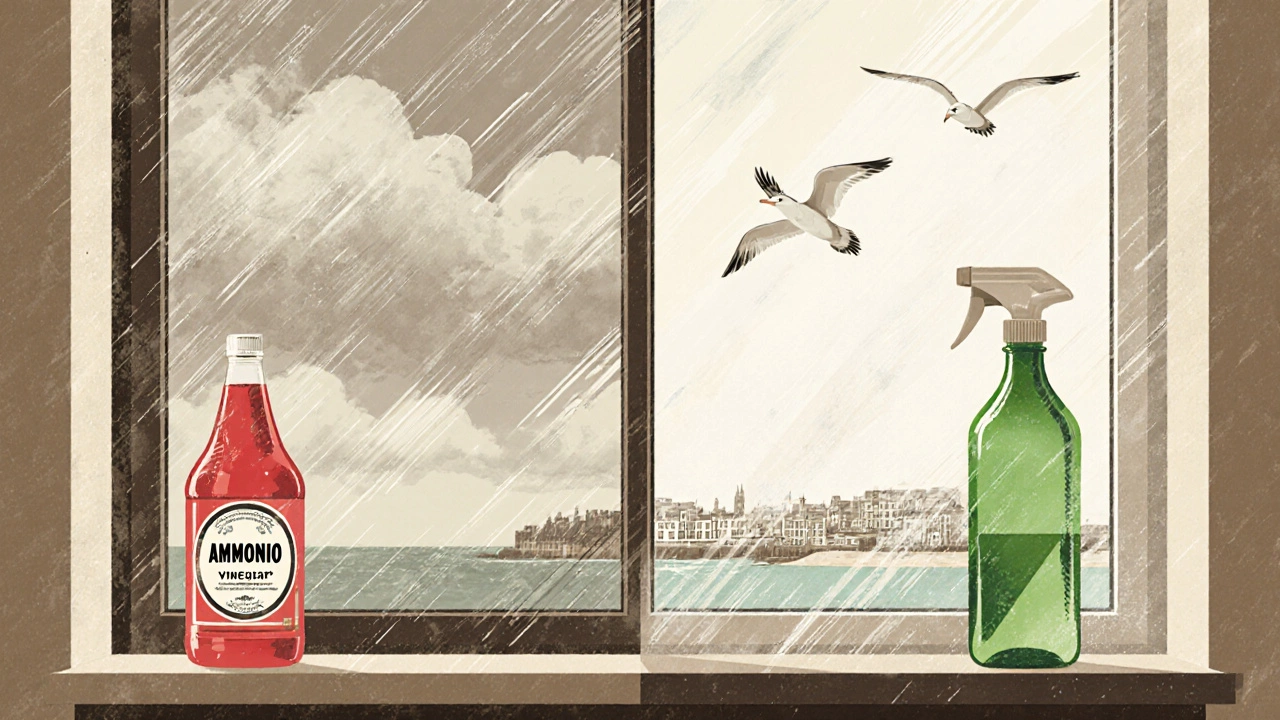
There are plenty of viral hacks online that sound great but fail in practice.
Stick to vinegar and distilled water. It’s been used for decades by professional window cleaners across the UK, especially in areas with hard water like the Midlands and the South Coast.
The solution is only half the battle. Your tools matter just as much.
Never use paper towels or cheap rags. They leave fibers and don’t absorb well. A good microfiber cloth lasts for years if cared for.
There’s no fixed rule, but here’s a practical guide based on location:
Spring and autumn are ideal times for deep cleaning. Avoid winter-frozen glass can crack if sprayed with cold liquid.
Every bottle of commercial window cleaner you buy adds to plastic waste and chemical runoff. Vinegar is biodegradable. Distilled water leaves no trace. Your cleaning solution doesn’t pollute waterways or harm pets if they lick the sill.
Plus, you’re reducing your reliance on single-use plastics. A single reusable spray bottle can last years. That’s one less bottle in the recycling bin every month.
In a 2025 survey of 200 households in Sussex, 89% reported their windows looked clearer after switching to vinegar and distilled water. One participant, a retired window cleaner from Hove, said: “I’ve cleaned glass for 40 years. This is the only mix I trust now. No fumes, no streaks, no guilt.”
It’s not magic. It’s science. And it’s been working for centuries.
Keep your homemade cleaner in a cool, dark place. Vinegar can break down over time if exposed to heat or sunlight. A cupboard under the sink is perfect. Label the bottle clearly-especially if you have kids or housemates.
And if you ever forget the recipe? Just remember: one part vinegar, one part distilled water. That’s all you need for windows that sparkle like new.
No. Apple cider vinegar has a brown tint and can leave a faint residue or discoloration on glass. White distilled vinegar is clear and odorless once dry-making it the only type suitable for window cleaning.
Yes. Tap water contains minerals like calcium and magnesium. When it dries, those minerals form white streaks or spots on the glass. Distilled water has no minerals, so it evaporates cleanly. Bottled distilled water is cheap and widely available in supermarkets.
Yes. Vinegar is mild enough not to damage factory-applied window tint. Avoid abrasive cloths or scrubbing. A soft microfiber cloth and light spraying are all you need.
Absolutely. Mirrors are just glass with a reflective coating. This solution won’t harm the backing. Many people use it specifically for mirrors because it leaves no streaks.
Indefinitely. Vinegar is a natural preservative. As long as it’s sealed in a clean bottle, it won’t spoil. If you notice cloudiness or particles, just make a fresh batch-it takes less than a minute.
Yes. Vinegar and water are non-toxic. However, never leave the spray bottle within reach of toddlers or pets. While the solution itself is safe, the bottle could be a choking hazard, and vinegar’s smell might upset sensitive noses.